


Build vs. Buy for Finance AI: What LinkedIn Won't Tell You
 Samuel Van Innis · · 6 min read
 Key Takeaways
- Finance professionals are rapidly experimenting with Claude and AI agents to automate close workflows, but most posts showcase early wins, not the full cost of ownership.
- Building your own AI finance workflows with general-purpose tools is genuinely faster and cheaper to start than ever before, but Version 1 is not where the cost lives.
- The hidden costs of DIY automation (maintenance, audit trails, institutional knowledge, and the time your team spends as both analysts and engineers) routinely exceed the cost of buying.
- Application companies still win because enterprise buyers are purchasing reliability, repeatability, security, and accountability. Not just code.
- The right question is not "can we build this?" It almost always is "should we own this?"
The LinkedIn Version of AI in Finance
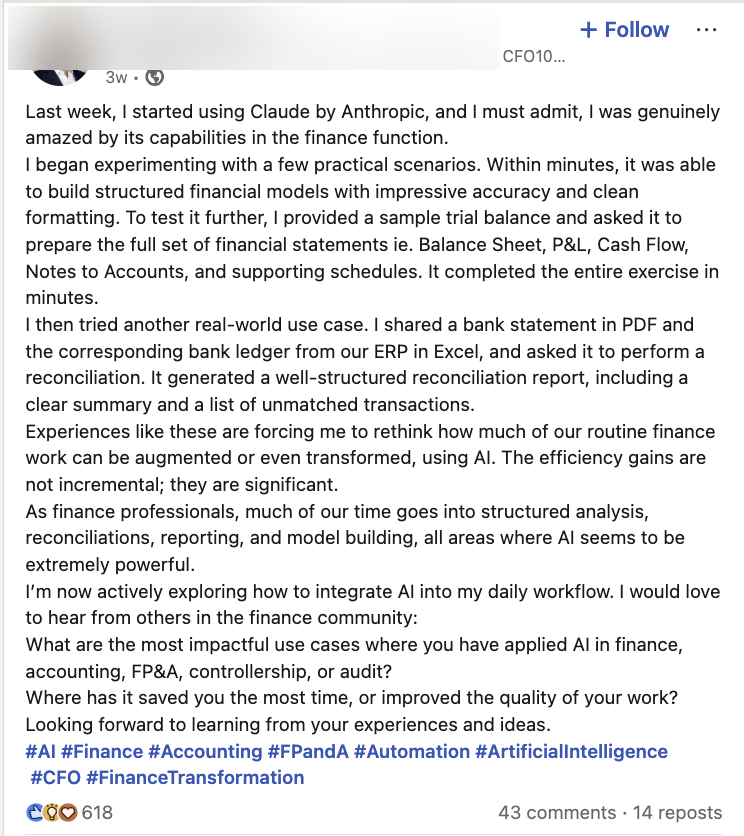
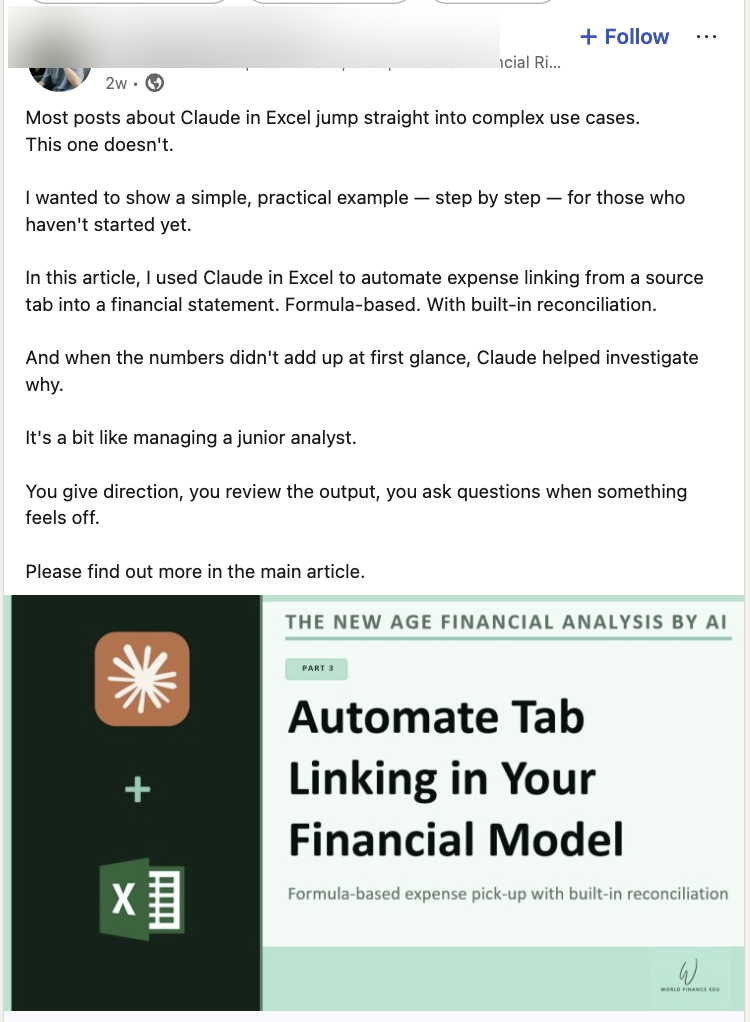
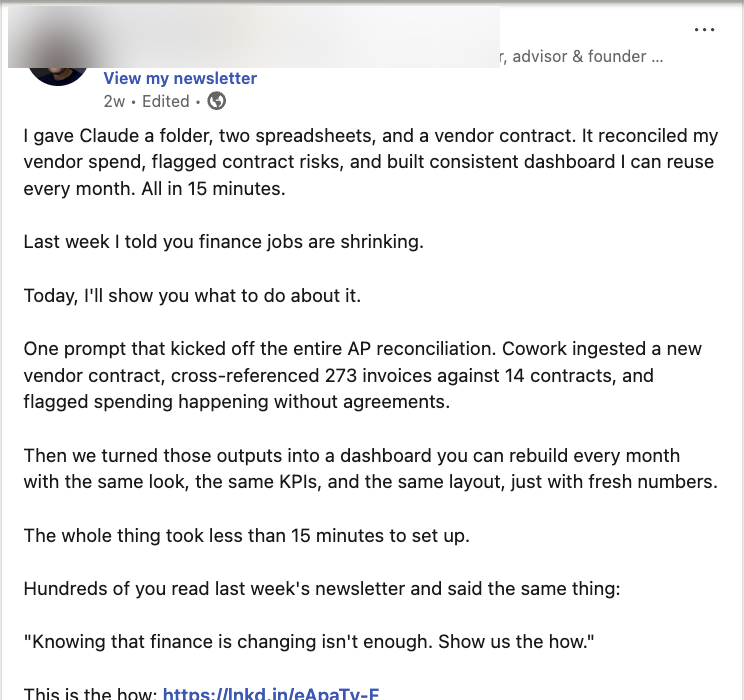
Open LinkedIn any morning in 2026 and finance professionals are sharing Claude workflows, Cowork automations, and Python scripts that process hundreds of AR transactions flawlessly. Accounts reconciled in under 60 seconds. Month-end close checklists built from scratch. Balance sheet matching that took two days now running overnight.
The results are real. But LinkedIn posts are highlights, not operating models, and the comments underneath tell a fuller story.
As one FP&A leader put it under a viral Claude-in-Excel thread: framing matters, and when context and structure aren’t clear, output drifts fast. Another noted that the more you use these tools, the more you realize the work still has to be done. The tools are fast; the process still needs judgment.
This is the build vs. buy debate, resurfaced in a new form.
What “Build” Actually Means for a Finance Team Today
Has AI changed what it means to build?
Yes, materially. Retool’s 2026 Build vs. Buy report found 35% of enterprise teams have already replaced at least one SaaS tool with a custom build, and 78% plan to build more this year. What once took a developer months now takes a finance analyst with Claude a few afternoons.
Tools like Claude Cowork let finance teams connect their ERP, work across many Excel files at once, and run parallel agents for reconciliation and variance analysis, all without code. For one-off and exploratory work, this is genuinely transformative.
But there is a meaningful gap between a workflow that works once and an accounting process your team can rely on, every close, without rework.
The Hidden Costs of DIY Finance Automation
Why do internal builds quietly become liabilities?
According to CFO Shortlist’s 2026 analysis of build vs. buy, internal finance tools rarely fail at launch. Teams ship a working prototype and declare success. Then iteration budgets shrink, the original developers move on, and institutional knowledge fragments. The tool becomes hard to change, not because the tech is obsolete, but because sustained ownership disappears.
For a finance team, that pattern has serious consequences.
Maintenance is underestimated. A reconciliation script that works against your March GL export breaks when the ERP renames a field in April or you add an entity in Q3. Someone has to catch it and fix it, usually the person who built it, mid-close.
Audit trails are not automatic. Auditors don’t want your prompt history. They want documented controls, version-controlled logic, and evidence that January’s process is December’s process. General-purpose AI workflows don’t produce that by default, and building it in is a separate project that gets deprioritized.
Accuracy is not reliability. A process can handle the standard cases and still fail silently on the edge cases that matter most: the ones that surface at year-end, during an audit, or when a new entity is added mid-year.
Your team is not a software team. Research from fintech.global makes the opportunity cost clear: skilled finance professionals are among the scarcest resources you have. Cycles spent maintaining automation are cycles not spent on analysis and strategic partnership.
Trust Is What You Buy
Dylan Scully, in Frontline VC’s analysis of the Claude Cowork era, put it plainly: enterprises buying application software are not buying code. They are buying battle-tested reliability, repeatability across teams, audited security, someone to hold accountable when things go wrong, and ongoing maintenance.
These are not features. They are structural properties of a product operated at scale, across many environments, over time. Code is cheap to generate; the institutional trust that makes software safe to depend on for financial reporting is not.
That hits hardest for mid-market teams running multiple legal entities and high transaction volumes, where complexity multiplies every edge case and the team responsible for the close is the same team that would have to maintain the custom system.
When Building Actually Makes Sense
Is there a legitimate case for building?
Yes, in bounded situations. Build vs. buy is not a philosophy question, it is a context question, driven by three variables: company stage, close complexity, and transaction volume.
Early-stage companies are the best DIY candidates: a single entity, one ERP, a small team, a close that fits in a spreadsheet. A well-prompted Claude or Cowork workflow covers most of the ground, maintenance is low, and audit requirements are light. Build here makes sense.
Growth-stage companies are where the calculus shifts. A second or third entity appears, volume outgrows manual review, and intercompany eliminations create complexity a general-purpose script was never built for. The close slows, not because the team got slower, but because the system hasn’t kept up. This is where homegrown tools quietly become liabilities.
Mid-market companies with multiple entities, high invoice volumes, and real audit exposure are where purpose-built software clearly earns its cost. A VAT misapplication a script misses in one entity ripples across consolidation; a missing accrual from a recurring vendor doesn’t surface until month-end. At this scale, maintaining a custom system competes directly with running the close.
As a rough guide:
- Build is likely sufficient when you have a single entity, under 500 invoices per month, one ERP, and audit requirements that are still manageable manually.
- Buy becomes the better answer when you have multiple legal entities, high transaction volumes, intercompany complexity, or a close that needs to be auditable, repeatable, and consistent regardless of who is running it.
The CFO Shortlist analysis describes the most durable 2026 model as structured systems augmented by flexible AI-native workflows: build and buy as complementary layers, not competing philosophies.
A controller who uses Claude to spot-check a reconciliation before signing off is using AI well. A controller who replaces their reconciliation process with a script they maintain themselves is accumulating technical debt while running a close.
What This Means for the Month-End Close Specifically
The month-end close is a poor candidate for a homegrown build. It is not exploratory or one-off: it runs every month, with real deadlines, audit exposure, and dependencies across systems and teams. For most mid-market teams it stretches past five days, and its insights arrive too late to shape the month. The gap is not smarter people, it is better processes, tooling, and institutional knowledge built into the system.
When an AI accounting agent learns that Vendor ABC always codes to cost center 500, that insurance premiums amortize over 12 months, and that intercompany follows specific allocation rules, that knowledge compounds. It does not leave when someone quits or break when the ERP updates. It lives in the process, not in a person or a script.
That is what purpose-built software does differently. The model isn’t smarter, the surrounding infrastructure, the integrations, audit trail, error detection, and task structure, was built for the close, not assembled from general-purpose parts.
Eagl: Built for the Close, Not Around It
At Eagl, we have watched this conversation with genuine interest, and we encourage finance teams to experiment with these tools firsthand. Trying them in your own environment is the fastest way to learn where they belong in your close. The question is not whether AI can transform the close, it is whether that transformation should be built from scratch or bought from a team that has already made it reliable.
Our AI accounting agents focus on the close work that actually eats time: continuous reconciliation that matches transactions throughout the month, financial controlling that catches VAT misapplications, cost-center miscodes, and timing errors before they compound, and accrual management that tracks recurring vendor patterns and flags missing invoices automatically. Every correction is captured and reused, so the process runs on embedded knowledge, not on whoever built the spreadsheet last quarter.
A faster close is not about whether you can automate it. It is about whether the automation is reliable enough to trust with your numbers.
What finance teams ask about build vs. buy
What is the build vs. buy decision for AI finance tools?
The build vs. buy decision asks whether your team should create custom AI workflows internally or purchase a purpose-built solution. For general-purpose tasks and exploratory analysis, building with tools like Claude is often faster and cheaper to start. For core accounting processes (reconciliation, the month-end close, accrual management), the hidden costs of maintenance, audit compliance, and reliability typically make purpose-built software the better long-term investment.
Can finance teams realistically build their own AI automations?
Yes, and many are doing it successfully for bounded tasks. Claude and tools like Cowork have made it possible for finance professionals to automate workflows without writing code. The challenge is not whether Version 1 works (it usually does). The challenge is whether your team can maintain, audit, and scale it reliably over time without diverting significant effort from the close itself.
What are the hidden costs of building AI finance workflows internally?
The most common hidden costs are maintenance when ERP exports or field names change, the absence of built-in audit trails that regulators expect, accuracy failures on edge cases the model wasn’t trained on, and the opportunity cost of finance professionals spending time as engineers instead of analysts. These costs rarely appear in the first month but tend to compound over time.
Why do application companies still win in an era of cheap AI code generation?
Enterprise buyers are not purchasing code. They are purchasing reliability from battle-testing, repeatability across teams, audited security, accountability when things go wrong, and ongoing maintenance. AI has made it cheaper to produce a working Version 1. It has not changed the structural cost of owning financial infrastructure that a company depends on for reporting accuracy and audit readiness.
When should a finance team buy instead of build?
Buy when the workflow is core to the close, runs repeatedly under deadline, carries audit exposure, or requires integrations across multiple systems. Buy when the cost of a failure (a missed accrual, a reconciliation error, a delayed close) is higher than the cost of a subscription. Build when the task is exploratory, one-off, or genuinely encodes proprietary logic that no vendor can replicate.
If your team is spending more time managing close infrastructure than running the close, request a demo to see what a purpose-built approach looks like in practice.
Sources
- Retool 2026 Build vs. Buy Report: https://sg.finance.yahoo.com/news/retool-2026-build-vs-buy-160000522.html
- CFO Shortlist — Build vs. Buy in 2026: https://www.cfoshortlist.com/reports/build-vs-buy
- Fintech Global — Build vs. Buy: Pricing Strategy Choices in 2026: https://fintech.global/2026/02/20/build-vs-buy-why-pricing-strategy-choices-matter-more-in-2026/
- Dylan Scully / Frontline VC — Why Application Companies Still Win: https://frontline.vc/blog/why-application-companies-still-win-when-code-is-free/
- Anthropic — Labor Market Impacts of AI: https://www.anthropic.com/research/labor-market-impacts
- Building Profit — Claude Cowork is the Best AI Agent for Finance: https://buildingprofit.substack.com/p/claude-cowork-is-the-best-ai-agent
About Eagl
Eagl is an agentic close management platform for high-volume, multi-entity finance teams, built to become the financial operating system for the office of the CFO. It runs account reconciliation, accrual management, and financial controlling on a data-quality layer that corrects errors as it automates, so output stays auditable. Finance teams including Reneo, Bluecrux, and Upvest rely on Eagl to close faster across multiple entities and currencies without sacrificing control.
Ready to see it in action?
Discover how Eagl transforms your financial operations with a personalized demo.
Request demoRelated articles

A Faster Close: How to Get There
The average finance team spends 6+ days closing their books each month. The technology, data, and processes needed to speed up the close already exist. What's missing is structure, focus, and the right foundation.

A New Way for Finance Teams
It is time for a new way of doing finance. From reactive to proactive, fast, accurately, and with confidence. A look at why the finance function is fundamentally broken — and how intelligent systems can fix it.

Accrual Management: A Complete Guide to Accruals, Prepayments, and Provisions
What accrual management is, the accrual lifecycle from booking to settlement, the main types of accruals every controller tracks, the challenges that trip teams up, and how continuous, automated tracking keeps your balance sheet clean.